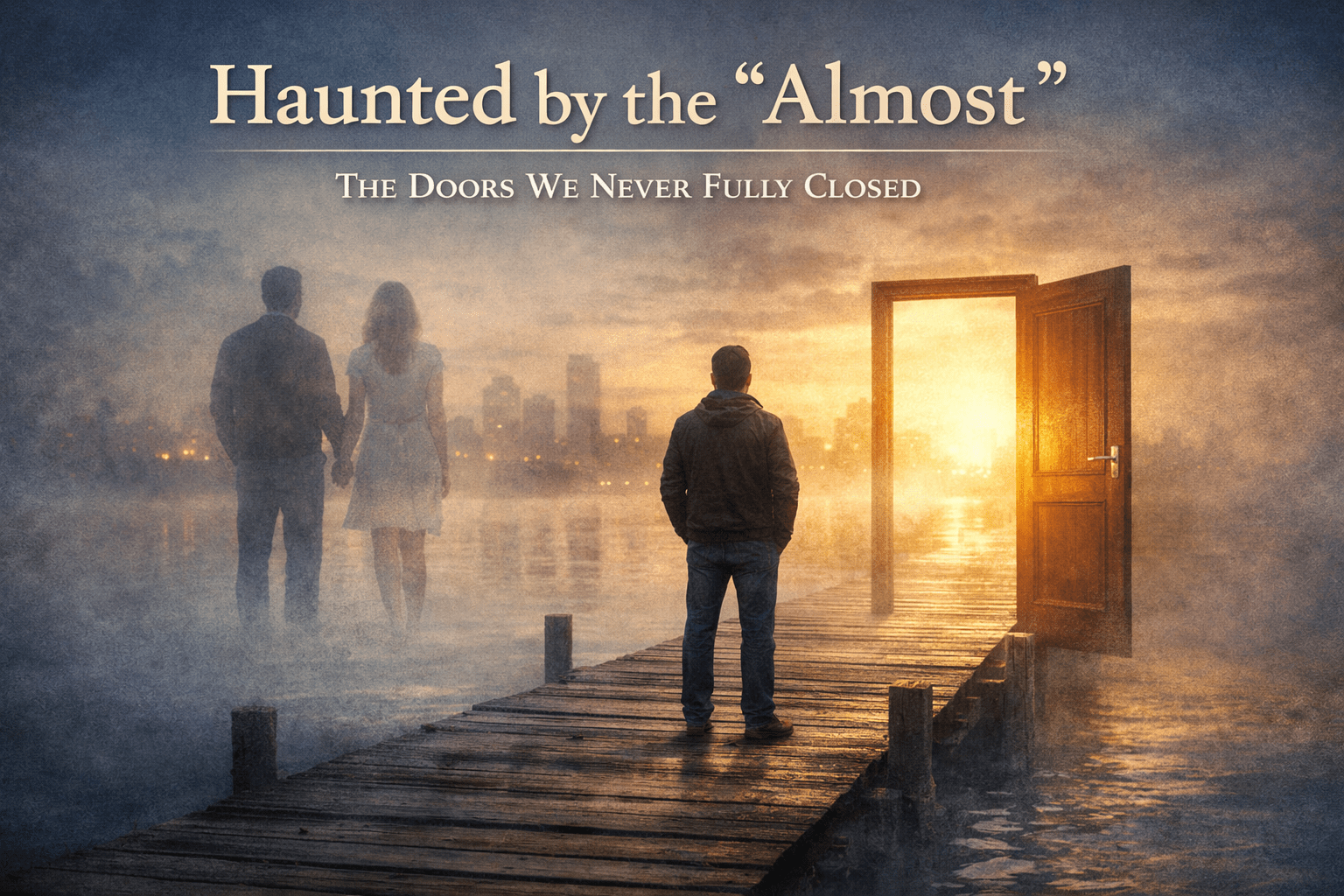
There is a reason certain moments stay with us longer than others.
Failure, as painful as it can be, has an ending. Something was tried, something didn’t work, and eventually the mind is forced to integrate that reality. There is disappointment, sometimes grief, but there is also definition. A door closes.
Almost is different.
Almost leaves the door open.
It lives in the space of possibility. The place where outcomes were never confirmed and where imagination is free to keep asking, What if? That openness is what gives almost its weight. It doesn’t resolve. It lingers.
This is why people are often haunted not by what they failed at, but by what nearly happened.
Why “Almost” Stays With Us Longer Than Failure
When something almost happens, the story never fully lands. There is no clear ending, no final answer, no moment where the mind can say, This is what it meant.
Instead, the experience remains unfinished.
Failure forces closure. Almost invites continuation.
The mind keeps returning to those moments, replaying conversations, revisiting decisions, imagining how one small change might have altered everything. Not as a form of self-punishment, but as a way of trying to understand who we were in that moment and who we might have become if things had shifted just slightly.
Almost stays alive because it was never dismissed as impossible.
The Psychology of Unresolved Choices
The human mind is drawn to unfinished stories. When a choice remains unresolved, it continues to ask for meaning.
Unresolved moments carry information. They reveal what mattered to us, what we hoped for, and what we were afraid to risk or lose. These moments don’t haunt us because we are weak or stuck in the past. They return because they shaped us in ways we never fully examined.
Almost is not about longing for a different life.
It’s about trying to understand the one we’re living.
How Memory Reshapes the Moments That Almost Were
Over time, memory changes these moments.
We don’t remember them exactly as they happened. We remember them as symbols. The almost becomes larger, heavier, and more meaningful than it may have felt at the time. It comes to represent an entire unlived version of ourselves, a path that still feels emotionally present even if it is no longer possible.
Memory simplifies and intensifies. It removes context and sharpens feeling. This is why certain almosts grow more vivid with age instead of fading away. They gather meaning as we become more aware of what was at stake.
Why Revisiting “Almost” Is Not Weakness
There is a cultural pressure to move on quickly, to treat reflection as indulgence and revisiting the past as a failure of resilience.
But returning to an almost is not weakness.
It is curiosity.
It is the mind and heart asking to understand something that shaped us without explanation. These moments return not because we are stuck, but because they still have something to teach.
When approached with honesty rather than judgment, almost often reveals values we didn’t yet have language for at the time. It shows us what we longed for, what we feared, and how we learned to adapt.
Almost is not a mistake.
It is a mirror.
How Stories Give Meaning to Unresolved Experiences
This is where stories matter.
Stories give us a way to explore unresolved moments without needing to fix them. They allow us to sit with ambiguity, to witness complexity, and to recognize ourselves without forcing resolution.
In story, almost doesn’t need to be solved. It needs to be understood.
This is why narratives about crossroads, missed connections, and quiet turning points resonate so deeply. They reflect something profoundly human: the way unfinished moments continue to live inside us and quietly shape who we become.
Many of the stories in Pieces of Our Past: Stories of Our Future explore this exact terrain. They follow characters living alongside moments that never fully resolved, discovering that the power of those moments lies not in what happened, but in how they shaped their inner lives.
Living With “Almost” Instead of Against It
Almost doesn’t ask to be corrected.
It asks to be acknowledged.
When we stop treating unresolved moments as failures and start seeing them as part of our inner landscape, something softens. The past loosens its grip. The present becomes more grounded.
We don’t need to relive those moments.
We need to understand them.
Because sometimes the lives we didn’t fully live still helped make us who we are.
And recognizing that can be quietly freeing. You can explore Pieces of Our Past: Stories of Our Future here
